The King, The Boy, and The Cousin


My first initial response to the reading of Yang's novel, American Born Chinese, was that of looking for and wondering how exactly Chinese folklore could tie itself into American Culture. Throughout the introduction to the tales of the Monkey King, I found myself asking what, and how this story was to have meaning to an American youth, besides the satisfying color, action and humorous antics of the little monkey with his sights set high. But then that’s it isn’t it? The monkey king is trying to be someone he is not. This does not really explain the other two stories of Jin Wang, and of Cousin Chin-Kee. Jin Wang seems to have conflicting interests and feelings towards Wei-Chen as the new kid at school. When Jin recalls the way he felt being new to the school it first brings back the terrible memories, but as he briefly relives these memories he comes to realize that his new found acquaintance is living these horrors for the first time. As Jin helps Chen through these tough times they become life long friends. Again, a great underlying theme for a children’s novel, but, I seem to be asking myself if these stories are truly connected. It is a stretch to assume that they have enough concrete connection based solely on the fact that the children are of Chinese ancestry. Something is missing here. The third installment of characters, Danny and his cousin Chin-Kee, seem to be, again setting up their relationship with each other, and the reader. No general serious plotline has been developed, but the underlying theme of Danny’s frustration with his cousin seems to be prevalent. I can easily see that danny will soon reject his cousin, denying to accept who his family really is, shutting Chin-Kee out of his life.

I would like to shed some focus on some of the visual aspects of A.B.C.
• The page before each segment begins displays a single panel. Each with a main character of the upcoming segment. Before Monkey King’s story, is a rendition of the Monkey King. Before the start of the tale of Jin and Chen is a depiction of Jin, and before the tale of cousin Chin-Kee is a depiction if his glorious arrival.

Reading Too Much?

Is it entirely possible to pick up a piece of literature, read it, understand, and digest it without relating and comparing it to the world around us? Human nature causes us to relate everything that we are confronted with to past experiences looking to relate it to something we know. We do this every second of the day, in a subconscious attempt to feel comfortable with the world around us. Like the first day of school, when one picks up a new book, it might seem very uncomfortable to them. But when something familiar is found that you can latch on to, this comfort level is drastically increased.
I would like to counter the initial question, with another. Is it possible to create a text without writing the world into it? Issues of race class and gender make a culture what it is. Most of the time these issues are not given a second look, but as hooks describes, it is very important to realize that these ideas of "Representation" and "Transformation" are happening and that popular culture is a major reflection of this occurrence. It is one of the easiest ways to “see” this in what we can relate to, and again are familiar with. It helps to see how we are represented, to relate it to our own lives.


In Peggy McIntosh's article "White Privilege" the idea of white privilege is illustrated with a series of ideas and statements that remind us of this "Invisible Blanket" white people seem to wear.
"46. I can chose blemish cover or bandages in "flesh" color and have them more or less match my skin."
i can honestly say that i never even considered this fact, and never, even when seeing a lighter toned bandage on someone of a darker skin color did i even interpret the fact that the bandage was made in mind for a person of light skin tone. i can see this as an example of how it is possible to have racial concepts still around us today, without us even considering it.

"17. I can talk with my mouth full and not have people put this down to my color."

i am also interested to see what #17 is really talking about. is it? i see it possible that some of the lines in this list can be applied to ANY culture, color, race or identity.

This needs a title.

The high tech lifestyle of the 21st Century has created the need for fluency in several languages. Not necessarily languages in the sense of Spanish, English, Chinese, Korean, etc, but the many forms of media that ideas are communicated. Texting, email, instant messaging, Facebook, even this blog have an expected style of format that is expected. Even without realizing it, we ourselves become more and more conditioned to the specific styles and formats of the medium we use to communicate. When i first made a Facebook profile page, I was unsure of the “guidelines” of how to use it. Was it like my old Myspace page? It seemed to have an air of greater formality. The rule of your profile name actually was your name. Peoples statuses seemed to actually reflect what they were doing, not some abstract song quote. It took some time, but gradually, to function well in the “Facebook world” I developed know-how. I tagged some pictures. I joined a group. And denied to add that creeper from elementary school. I still find myself unsure of how to write in this blog medium.
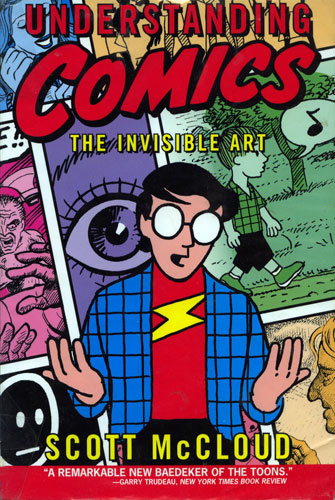
In the same sense, even if you can produce media, you also need to be able to interpret what others produce. Communication is a two way street. Generally the greatest speakers are also great listeners. Great writers are well read. As McCloud explains in his “Sequential Art/Comic” many artists will search for a great influence to model their work after. They focus their works on someone else’s greatness, while striving for their own unique “new” creation. As a musician myself, I find understanding with this influence. I have listened over and over to various recordings of great trumpet players such as Maynard Ferguson and Wynton Marsalis. (Wynton Marsalis playing Carnival of Venice) although never intending to duplicate their playing, I find that I have taken things that great trumpet players used, an applied them to my own musicianship. I hold my trumpet the same way that Ferguson did. Small influences from a great many of media affect the way we produce our own mark.
I disagree with Williamson’s take on multimodality in the classroom. Granted, as technology has evolved and changed the world around us, so has the classroom, but I say that the classroom has always been adapting to what students needed. There never was a day when teachers “just spoke” to their pupils. The classroom setting has however evolved to offer more “hands on learning” for things that are being developed at the time. Surely it would seem ridiculous for schools to teach proper etiquette on how to send a telegram. It would not surprise me if schools stopped teaching students how to write in cursive. When was the last time you used it? Im not even sure if I still can…Students are more or less taught what the will be using in the five to ten years after they leave the classroom.

McCloud’s comic demonstrates a great take on the five areas of multimodal literacy: linguistic, visual, spatial, gestural, and audio. It really amazes me how the human mind can interpret what it obtains visually, and apply it to the other four senses. His renditions of sound effect are symbolized with bold italic capital letters outlined in shapes that draw our mind to that sound. Words that need more emphasis are bolded out, sometimes in capital letters.
Phew.
Enough for now. I might come back to this later, but its time for bed.

Comics. A Textbook Take.

After reading the first portion of Scott McCloud's Understanding Comics i still don't find myself understanding them very well. most everyone has read a comic or two since their childhood. As a eleven year old i was an avid reader of Jim Davis' Garfield. I still read the funnies page in the Sunday newspaper, but even these years of experience have not given me much insight into the inner workings of the graphic novel. McCloud's first chapter (comics have chapters?what?) dives into the depths of the history of the comic, and how ancient Egyptians used their resources to illustrate their stories with a pictorial alphabet. i find them much easier to read now that i have learned that they should be read from the bottom left to the top right.

Do you see what I see?


American Gothic is a symbol of a classic American Dream. Painted by Grant Wood in 1930, it portrays a man and woman standing in front of their farm. But as McCloud's work reminds us, we are only really implying that they are standing, as only their upper bodies are shown. Why is that? what influences our take on the picture? apart from the contrast in expression between the man and the woman, which is depicted by the threatening, sharp cornered eyes of the woman, the intriguing rounded look of his eyes, and the tight corners of both of their mouths. as i look at the man, i can find several situations playing out before me. the threatening stance of the pitchfork hints that the man is defending himself before the farm. His extra height over the woman, combines with the slight of the fork to portray a sharp witted man. On a lighter side, the soft tones of the pale white house, and the clear blue sky, can soothe us into a feeling of being home. even if the house is nothing like the one a viewer necessarily lives in, he/she can still find themselves feeling like home.

I get bored sometimes


My poem can be found here

The first time reading this, i could totally see myself in the voice's position. Bored. We all get bored, we've all been bored. i find myself feeling guilty about my boredom after the fact. like i think back on what i was doing..hours..days...weeks ago and wonder if those moments were truly wasted. i ask myself what i could have accomplished if i had been doing something productive. i always think of great minds as people who managed what they were doing with their time in a productive and meaningful way.
But what about those times where you cant really do much about the boredom? what about the times where you are almost forced into the situation. is there much you can do about it? is there much you should do about it?
Some of the things we do in life, such as household chores, and schoolwork are necessary pains that help us to attain the true goal of what we truly want.
and when we reach our goal of what we wish, human nature does not allow for satisfaction at that status. we always find ourselves looking for what we can't have, aren't doing, can't be, or haven't achieved.
Margaret Atwood talks of her boredom of, what i can only see as her childhood, as a time where she was doing things not because she wanted to do them, but because it was necessary.
things like sitting in the back seat, hauling wood, and doing the dishes.
The people who you spend the time with that get you through the boredom are the ones you grow to love, and as Atwood shows in the conclusion of her poetry, sometimes when the person is gone from your life, you truly appreciate the time you spent.


What is an American..?

What defines an American?
As a person, an American is seen as someone with great opportunity in a free society that is usually identified with the United States. But are those who live in Canada, Mexico, or the Middle and south Americas still American by title? Are they not too identified by the same overlapping title?
for identifications sake, they truly are, but an American is also defined as someone who is in pursuit of the age-old American "dream". Someone who pursues their rights to life, liberty and happiness. Great work and sacrifice is required to fulfill these great goals. Those willing to take the back seat to these ideas are not truly an American.