Final Evaluation

Wahoo! Its Over! Last 8am Class!
But Seriously, Lets not schedule something this early ever again.
When i picked up the book list for this class and set out to the bookstore with my Visa card, i found myself thinking things like "Why would I ever want to read this" and "Who really reads graphic novels, aren't they a little childish?" I grumbled and groaned all the way to the checkout, my friends taunting me all the way. The first texts Mcloud's and AMC, had little effect on me. I saw them as an instruction manual and a children’s book respectively. AMC was entertaining, and had a clear message, but it really only reinforced (my) idea that graphic novels were childish, I still had that “no big deal” mindset. When we go to the classical literature, I gained a little more faith in the course. The texts of Bluest Eye, Oranges, were closer to what I was used to. I had experience diving into a classical text and digging out anything and everything necessary to prove my point. I considered myself a pro. This class was going to be easy. But wait, ask a Question? In my writing? Uh-Oh. The five response papers added a whole new writing style that was something completely different from anything I had ever needed to produce before. In previous courses, at Western, and in High School, I was used to a topic being presented, and having my writing be very set and structured. This newfound freedom was very unusual to me. I was like a dog off its leash. What do I do? Where do I go? I missed that overbearing shadow of direction, but I liked the space I had to roam.
I don’t think I came to truly appreciate a graphic novel until I read MAUS. Apart from it being my favorite text of the semester, MAUS changed all of my ideas towards the graphic novel. It was a true story. It certainly was not a children’s book. MAUS presented a eye opening form to the horrors of the Holocaust in a way that was not necessarily easier to read, but easier to ‘soak in’. I find that when I read a straightforward text, I glaze over the numbers and it might not have as much of an effect. Spiegelman made things a little more personal. And although it might have made MAUS a little harder to read from and emotional standpoint, the effectiveness of his illustrations certainly garner its numerous awards.
I really didnt like the Gaiman version of M.N.D. as much as the other versions. Although i am still not a fan of the 'graphic manga' the Gaiman version was just terrible. After experiencing four other forms of M.N.D. i find that this version is quite under par. although i was reading the black and white version of what was probably full of wonderful color, i still did not find the same enjoyment and feeling out of the text. it was neat that Gaiman actually included 'Will Shakespare" in the text as a character, but it still doesnt save it completely for me. again, im not sure if it was due to the photocopy, but i felt that lots of the content of the story were left out. much of the interplay between characters left me confused.
Pyramus and Thisbe, the fantastic work of star actors coming together to produce a masterpiece production of large scale, and great grandeur. Haha. Right.

The play-within-the-play produced by the “Rude Mechanicals” seeks to employ and parallel the same theme of dramatic, romantic confusion played by normal average every day commoners. .....interestingly, to me the plot of Pyramus and Thisbe seems to be very close to that of Shakespeare’s Romeo and Juliet.
Thus die I, thus, thus, thus.
Now am I dead,
Now am I fled;
My soul is in the sky:
Tongue, lose thy light;
Moon take thy flight:

You Took My Shakespeare

When I think about how much Shakespeare has given the literary world, I find it hard to find works that have not, in some way, been influenced and affected by his writing.
Direct ‘mock ups’ of Shakespeare are not appropriate, and are disrespectful to the true works, but it Is nearly impossible to steer completely away from shakespearian influence. How many of today’s works are “Love-Tragedies”? The tragedy of Romeo and Juliet has given life to most of today’s dramatic literature.
Bottom Line: If you’re going to do it, do it well.
this has to be the worst remake ever thought of.
sorry, but Shakespeare in a rave setting...is not a good idea
http://www.youtube.com/watch?v=NvnCjEZoehw

language in literature; Midsummer Night's Dream

How happy some o'er other some can be!
Through Athens I am thought as fair as she.
But what of that? Demetrius thinks not so;
He will not know what all but he do know:
And as he errs, doting on Hermia's eyes,
So I, admiring of his qualities:
Things base and vile, folding no quantity,
Love can transpose to form and dignity:
Love looks not with the eyes, but with the mind;
And therefore is wing'd Cupid painted blind:
Nor hath Love's mind of any judgement taste;
Wings and no eyes figure unheedy haste:
And therefore is Love said to be a child,
Because in choice he is so oft beguiled.
As waggish boys in game themselves forswear,
So the boy Love is perjured every where:
For ere Demetrius look'd on Hermia's eyne,
He hail'd down oaths that he was only mine;
And when this hail some heat from Hermia felt,
So he dissolved, and showers of oaths did melt.
I will go tell him of fair Hermia's flight:
Then to the wood will he to-morrow night
Pursue her; and for this intelligence
If I have thanks, it is a dear expense:
But herein mean I to enrich my pain,
To have his sight thither and back again.


Jealous Much?

She considers herself to be as beautiful as Hermia, but who cares?...if Demetrius doesn't think so, which is all that matters, it doesn't matter. his mistake is obsessing over Hermia, her mistake is obsessing over him.
Love makes the worthless, beautiful. love is blind. and unjudgemnental, as a child. it makes bad choices.


Midsummer Night's Dream

As indicated by the title, Dreams are a key theme for Midsummer Night's Dream. They are linked to the bizarre mishaps in the forest. This theme of dreams reoccurs throughout the story/play in a way for the characters to explain the strange happenings that are occurring. The entire plot of Midsummer Night's Dream is questioned to be real, and considered to just have been a dream.
"If we shadows have offended,
Think but this, and all is mended,
That you have but slumbered here
While these visions did appear.
And this weak and idle theme,
no more yielding
but a dream..."
with a small amount of restored confidence, and even a slight amount of hope, a persons entire outlook can change. contrast the panels on page 188 vs the panels on page 194. in the first panels we see vladek stripped of all his belongings, all of his possessions, and all of his hope. he admits to himself that this is the place he will die. life is horrible. there is no light at the end of the tunel....by page 188, although he does not have much, he does gain a new level of confidence. depicted by the way he stands, and is depicted in the pannels as sharp and more sophistocated. even as a pow, he mannages to still generate a enduring character. he is only given clothes that fit, and and some food, but this seems to be everything to the man who has nothing.
i chose to read the short exert written by spiegelman called "Getting in Touch with My Inner Racist" ....
i find that he has a point with this article; not all racism is intentionally taught to future. children unintentionally learn it from popular culture and the world around them, automatically placing themselves into a racial stereotype. Spiegelman's first hand witnessing of this with his children, causes him to think of his parents struggles through the holocaust(MAUS). even with the effect his parents struggle, his children still are effected by the racism in culture today.


Spiegelman use of animals in his graphic novel may seem superficial, but it helps his works to show the stupidity of classifying people on race, gender, nationality, or faith. his 'comic' representation of different people as animals shows how ridiculous the idea is. The Jews for example [represented as mice] can be seen as the helpless 'victims' of the Nazi' regime. The Nazi's threatening appearance [of cats] add to this satire. the jews, in order to hide themselves from the Nazis, wear the mask of a normal polish person... pg66.. Spiegelman even goes as far to Americans represented as dogs, adding to the satire of the idea, which breaks down towards MAUS II; when the reporters are depicted wearing masks of race [nazi, jewish etc]...pg202...


...i actually found a web resource that talks about the unrest of some polish people as being rendered as pigs; turns out that the representation should be seen as a comical 'miss piggy' style.

any ideas?

im looking to develop a research of ideas of how one's self is "characterized" by their actions, possessions, and the people they are surrounded with. not necessarily about self image, but the placement of the "self" amongst others. how does one fit in? how does one change theirself to meld into the norm.

nom nom nom nom nom

"There is much pain here. Some people think you can have your cake and eat it. the cake gets mouldy and they choke on what's left. going back after a long time will make you mad, because the people you left behind do not like to think of you changed, will treat you as they always did, accuse you of being indifferent, when you are only different"(Whinterson 160-61).

Jeanette Winterson uses a rendition of the classic line "you can't have your cake and eat it too..."
to describe people's indifference to change. people remember you as they...remember you. when this idea changes, it is sometime rejected, and found to be repulsive. but, like a piece of cake that gets moldy, things are not around forever.

Oranges

I would like to take the analogy to The Matrix’s idea of choosing to believe one step further. Instead of taking the blue pill, or the red pill, instead I like to see belief as more of vitamin supplement. There are several kinds out there, but only you can choose which one is right for you. If you miss a few days of not taking the pill, it wont kill you, and you can pick it right back up again when you find it necessary. Other vitamins might do the same thing for me, and I can’t really prove that any of the others are the wrong choice. I do know that when I get sick, it is usually because I have not been taking my vitamins.

My beliefs have been significantly challenged. As a conservative pre-med major I sometimes find it very difficult to bury down the “knowledge” that I have gained on my Sunday mornings. My biology courses talk of Darwin, Evolution, Natural Selection, Genetic Drift, and call the Big Bang as the key influences of who we are today. I pretend to believe this for the exam, but I find that I still resort back to my roots in the church for my true beliefs.

Oranges seems to ignore or avoid anything that it does not accept. Up until now, whenever Janette encounters something that her mother does not like, or finds inappropriate for the mind of a faithful child, she [the mother] removes it completely from her life. The book foreshadows that Janette is homosexual. In the beginning of the book Janette gets her comic books from two women who like to give her treats of banana bars, Janette finds the ladies strange, but does not know exactly what it is about the women that make her different. When her mother attempts to repress the homosexual influence in Janette’s life, she offers her an orange, which seems to represent heterosexuality moreover they represent the entire repressive system that Jeanette's mother espouses.

Oranges

I would like to take the analogy to The Matrix’s idea of choosing to believe one step further. Instead of taking the blue pill, or the red pill, instead I like to see belief as more of vitamin supplement. There are several kinds out there, but only you can choose which one is right for you. If you miss a few days of not taking the pill, it wont kill you, and you can pick it right back up again when you find it necessary. Other vitamins might do the same thing for me, and I can’t really prove that any of the others are the wrong choice. I do know that when I get sick, it is usually because I have not been taking my vitamins.

My beliefs have been significantly challenged. As a conservative pre-med major I sometimes find it very difficult to bury down the “knowledge” that I have gained on my Sunday mornings. My biology courses talk of Darwin, Evolution, Natural Selection, Genetic Drift, and call the Big Bang as the key influences of who we are today. I pretend to believe this for the exam, but I find that I still resort back to my roots in the church for my true beliefs.

Oranges seems to ignore or avoid anything that it does not accept. Up until now, whenever Janette encounters something that her mother does not like, or finds inappropriate for the mind of a faithful child, she [the mother] removes it completely from her life. The book foreshadows that Janette is homosexual. In the beginning of the book Janette gets her comic books from two women who like to give her treats of banana bars, Janette finds the ladies strange, but does not know exactly what it is about the women that make her different. When her mother attempts to repress the homosexual influence in Janette’s life, she offers her an orange, which seems to represent heterosexuality moreover they represent the entire repressive system that Jeanette's mother espouses.

Apoligies, and a Warning

I posted my blog a few hours ago.
and lucky enough i checked it.

i stole a link to an image of American Born Chinese....and got caught doing it, thus it was replaced with an image that some people might not find exactly pleasant.

it has been removed, and i apologise to anyone who was offended by it.

may this be a warning to any future posts of media on this blog.
be careful!

Acceptance, Connections, Big White Culture

I find the Youtube video black doll vs. white doll to be quite saddening. After reading The Bluest Eye, I had assumed that perhaps the prevalence of the feelings of white beauty would not be as high. According to the small sample of the video, these ideas are still present.

I have a few problems with Kiri Davis' video experiment.

  • The video has obviously been edited, but has it been edited to show only the results Ms. Davis wants to show?

  • Ms. Davis only shows black children being interviewed. I am very interested to see if a survey of children from other races would also choose the white doll. What happens if you add a third doll of Latino or Asian complexion?

At face value the video does show that the message preached by Toni Morrison, and Bell Hooks still applies to us today. Even Yang's American Born Chinese reminds us of the cultural dominance whites hold over other races. Yang exaggerates the way Chinese American youths view themselves with the characterization of Chin Kee

Another theme, quite prevalent in both texts, is the search for self-acceptance. Yang and Morrison show that the dominance of white culture causes the children to never truly accept who they are. The man behind the counter look down on Pecola, it must be because she is black, not because he is taller than her. He uses short language with her, it is not because she doesn’t speak, it is because she is ugly…
“The distaste must be for her, her blackness…”(Morrison 49).

Taking off Those Glasses

As the story of Jin's self discovery comes to a close, and he learns the true identity of the monkey king, yin wang, and most importantly, himself, he attempts to repair the friendship he and wei chen once shared. his discussion with chen is initailly hostile as he convinces chen to give him a chance and to hear him speak. as chen slowly lets the barrier down and returns to their friendship, the friendship is visually repaired by the removal of chen's sunglasses. p282
http://www.youtube.com/watch?v=X2EDtxEumFI

The King, The Boy, and The Cousin


My first initial response to the reading of Yang's novel, American Born Chinese, was that of looking for and wondering how exactly Chinese folklore could tie itself into American Culture. Throughout the introduction to the tales of the Monkey King, I found myself asking what, and how this story was to have meaning to an American youth, besides the satisfying color, action and humorous antics of the little monkey with his sights set high. But then that’s it isn’t it? The monkey king is trying to be someone he is not. This does not really explain the other two stories of Jin Wang, and of Cousin Chin-Kee. Jin Wang seems to have conflicting interests and feelings towards Wei-Chen as the new kid at school. When Jin recalls the way he felt being new to the school it first brings back the terrible memories, but as he briefly relives these memories he comes to realize that his new found acquaintance is living these horrors for the first time. As Jin helps Chen through these tough times they become life long friends. Again, a great underlying theme for a children’s novel, but, I seem to be asking myself if these stories are truly connected. It is a stretch to assume that they have enough concrete connection based solely on the fact that the children are of Chinese ancestry. Something is missing here. The third installment of characters, Danny and his cousin Chin-Kee, seem to be, again setting up their relationship with each other, and the reader. No general serious plotline has been developed, but the underlying theme of Danny’s frustration with his cousin seems to be prevalent. I can easily see that danny will soon reject his cousin, denying to accept who his family really is, shutting Chin-Kee out of his life.

I would like to shed some focus on some of the visual aspects of A.B.C.
• The page before each segment begins displays a single panel. Each with a main character of the upcoming segment. Before Monkey King’s story, is a rendition of the Monkey King. Before the start of the tale of Jin and Chen is a depiction of Jin, and before the tale of cousin Chin-Kee is a depiction if his glorious arrival.

Reading Too Much?

Is it entirely possible to pick up a piece of literature, read it, understand, and digest it without relating and comparing it to the world around us? Human nature causes us to relate everything that we are confronted with to past experiences looking to relate it to something we know. We do this every second of the day, in a subconscious attempt to feel comfortable with the world around us. Like the first day of school, when one picks up a new book, it might seem very uncomfortable to them. But when something familiar is found that you can latch on to, this comfort level is drastically increased.
I would like to counter the initial question, with another. Is it possible to create a text without writing the world into it? Issues of race class and gender make a culture what it is. Most of the time these issues are not given a second look, but as hooks describes, it is very important to realize that these ideas of "Representation" and "Transformation" are happening and that popular culture is a major reflection of this occurrence. It is one of the easiest ways to “see” this in what we can relate to, and again are familiar with. It helps to see how we are represented, to relate it to our own lives.


In Peggy McIntosh's article "White Privilege" the idea of white privilege is illustrated with a series of ideas and statements that remind us of this "Invisible Blanket" white people seem to wear.
"46. I can chose blemish cover or bandages in "flesh" color and have them more or less match my skin."
i can honestly say that i never even considered this fact, and never, even when seeing a lighter toned bandage on someone of a darker skin color did i even interpret the fact that the bandage was made in mind for a person of light skin tone. i can see this as an example of how it is possible to have racial concepts still around us today, without us even considering it.

"17. I can talk with my mouth full and not have people put this down to my color."

i am also interested to see what #17 is really talking about. is it? i see it possible that some of the lines in this list can be applied to ANY culture, color, race or identity.

This needs a title.

The high tech lifestyle of the 21st Century has created the need for fluency in several languages. Not necessarily languages in the sense of Spanish, English, Chinese, Korean, etc, but the many forms of media that ideas are communicated. Texting, email, instant messaging, Facebook, even this blog have an expected style of format that is expected. Even without realizing it, we ourselves become more and more conditioned to the specific styles and formats of the medium we use to communicate. When i first made a Facebook profile page, I was unsure of the “guidelines” of how to use it. Was it like my old Myspace page? It seemed to have an air of greater formality. The rule of your profile name actually was your name. Peoples statuses seemed to actually reflect what they were doing, not some abstract song quote. It took some time, but gradually, to function well in the “Facebook world” I developed know-how. I tagged some pictures. I joined a group. And denied to add that creeper from elementary school. I still find myself unsure of how to write in this blog medium.
In the same sense, even if you can produce media, you also need to be able to interpret what others produce. Communication is a two way street. Generally the greatest speakers are also great listeners. Great writers are well read. As McCloud explains in his “Sequential Art/Comic” many artists will search for a great influence to model their work after. They focus their works on someone else’s greatness, while striving for their own unique “new” creation. As a musician myself, I find understanding with this influence. I have listened over and over to various recordings of great trumpet players such as Maynard Ferguson and Wynton Marsalis. (Wynton Marsalis playing Carnival of Venice) although never intending to duplicate their playing, I find that I have taken things that great trumpet players used, an applied them to my own musicianship. I hold my trumpet the same way that Ferguson did. Small influences from a great many of media affect the way we produce our own mark.
I disagree with Williamson’s take on multimodality in the classroom. Granted, as technology has evolved and changed the world around us, so has the classroom, but I say that the classroom has always been adapting to what students needed. There never was a day when teachers “just spoke” to their pupils. The classroom setting has however evolved to offer more “hands on learning” for things that are being developed at the time. Surely it would seem ridiculous for schools to teach proper etiquette on how to send a telegram. It would not surprise me if schools stopped teaching students how to write in cursive. When was the last time you used it? Im not even sure if I still can…Students are more or less taught what the will be using in the five to ten years after they leave the classroom.

McCloud’s comic demonstrates a great take on the five areas of multimodal literacy: linguistic, visual, spatial, gestural, and audio. It really amazes me how the human mind can interpret what it obtains visually, and apply it to the other four senses. His renditions of sound effect are symbolized with bold italic capital letters outlined in shapes that draw our mind to that sound. Words that need more emphasis are bolded out, sometimes in capital letters.
Phew.
Enough for now. I might come back to this later, but its time for bed.

Comics. A Textbook Take.

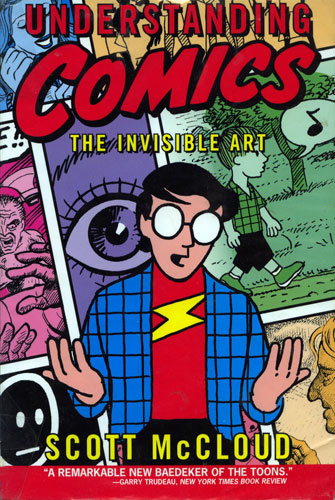
After reading the first portion of Scott McCloud's Understanding Comics i still don't find myself understanding them very well. most everyone has read a comic or two since their childhood. As a eleven year old i was an avid reader of Jim Davis' Garfield. I still read the funnies page in the Sunday newspaper, but even these years of experience have not given me much insight into the inner workings of the graphic novel. McCloud's first chapter (comics have chapters?what?) dives into the depths of the history of the comic, and how ancient Egyptians used their resources to illustrate their stories with a pictorial alphabet. i find them much easier to read now that i have learned that they should be read from the bottom left to the top right.

Do you see what I see?


American Gothic is a symbol of a classic American Dream. Painted by Grant Wood in 1930, it portrays a man and woman standing in front of their farm. But as McCloud's work reminds us, we are only really implying that they are standing, as only their upper bodies are shown. Why is that? what influences our take on the picture? apart from the contrast in expression between the man and the woman, which is depicted by the threatening, sharp cornered eyes of the woman, the intriguing rounded look of his eyes, and the tight corners of both of their mouths. as i look at the man, i can find several situations playing out before me. the threatening stance of the pitchfork hints that the man is defending himself before the farm. His extra height over the woman, combines with the slight of the fork to portray a sharp witted man. On a lighter side, the soft tones of the pale white house, and the clear blue sky, can soothe us into a feeling of being home. even if the house is nothing like the one a viewer necessarily lives in, he/she can still find themselves feeling like home.

I get bored sometimes


My poem can be found here

The first time reading this, i could totally see myself in the voice's position. Bored. We all get bored, we've all been bored. i find myself feeling guilty about my boredom after the fact. like i think back on what i was doing..hours..days...weeks ago and wonder if those moments were truly wasted. i ask myself what i could have accomplished if i had been doing something productive. i always think of great minds as people who managed what they were doing with their time in a productive and meaningful way.
But what about those times where you cant really do much about the boredom? what about the times where you are almost forced into the situation. is there much you can do about it? is there much you should do about it?
Some of the things we do in life, such as household chores, and schoolwork are necessary pains that help us to attain the true goal of what we truly want.
and when we reach our goal of what we wish, human nature does not allow for satisfaction at that status. we always find ourselves looking for what we can't have, aren't doing, can't be, or haven't achieved.
Margaret Atwood talks of her boredom of, what i can only see as her childhood, as a time where she was doing things not because she wanted to do them, but because it was necessary.
things like sitting in the back seat, hauling wood, and doing the dishes.
The people who you spend the time with that get you through the boredom are the ones you grow to love, and as Atwood shows in the conclusion of her poetry, sometimes when the person is gone from your life, you truly appreciate the time you spent.


What is an American..?

What defines an American?
As a person, an American is seen as someone with great opportunity in a free society that is usually identified with the United States. But are those who live in Canada, Mexico, or the Middle and south Americas still American by title? Are they not too identified by the same overlapping title?
for identifications sake, they truly are, but an American is also defined as someone who is in pursuit of the age-old American "dream". Someone who pursues their rights to life, liberty and happiness. Great work and sacrifice is required to fulfill these great goals. Those willing to take the back seat to these ideas are not truly an American.